

Chiquita… I have always loved bananas. When I first moved to the UK, years before this country would become home in the fullest sense, one of the first pieces of practical wisdom I received from a friend was beautifully simple: “If you want good bananas here, buy Chiquita.” I still remember thinking this was an oddly specific immigration tip. Some people tell you about the weather, rent, council tax, GP registration and which side of the road to look before crossing. My friend gave me the real survival guide: find the right banana. And to be fair, he was right. Chiquita bananas really are excellent. I would describe them as 108% banana: a banana with enhanced banana magic. A banana that has understood its purpose READ MORE
Structures

When Sancho Starts Dreaming…
Don Quixote is one of my favourite books. At its simplest, it is the story of an ageing man who reads so many tales of chivalry that he begins to live inside them. He renames himself Don Quixote, puts on old armour, mounts a tired horse, and rides out to restore honour to the world. Beside him is Sancho Panza, practical, earthy, amused, and often hungry, who follows as companion, witness, and occasional anchor to reality. One of them sees giants where there are windmills. The other usually sees windmills. Today, if Don Quixote had access to AI and predictive analytics, I suspect he would still charge the windmill. He would simply do it with greater confidence, a cleaner dashboard, and perhaps a short note READ MORE

Even AI Skips the Small Talk
“How is your day going?” It is a small question. Almost automatic. We ask it without thinking and answer it without meaning. “Good.” “Not bad.” “Busy.” And then we move on. But it was never really about the answer. It is a signal. A quiet way of saying, I see you, you exist, we are both here. Across cultures, this shows up in different forms. In London, it becomes “You alright?”, something I could never quite pick. It sounds like concern, but rarely expects an answer. And then there is “You okay?”, which I would hear quite a lot. The first few times, it genuinely confused me. It often sounded like “U.K.”, and for a moment I would wonder what exactly I was being asked. READ MORE
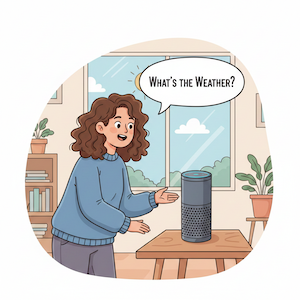
“What’s the Weather?” Said the Human
“What’s the weather today?” is such an ordinary question that we barely notice the complexity behind it. A voice assistant gives us a calm, simple answer, and we decide whether to carry an umbrella, change travel plans, or dress differently. Hidden behind that answer are forecasts, data sources, probabilities, model assumptions, and uncertainty. The interaction feels effortless because the complexity has been compressed into a single response. That simple exchange led me to think about a broader question: where do the most significant failures in modern systems actually come from? The instinctive answer is usually software bugs. Yet many of the most costly incidents in technology, finance, healthcare, transportation, and public services emerge from something more subtle. Systems often behave exactly as they were designed READ MORE