Chiquita…
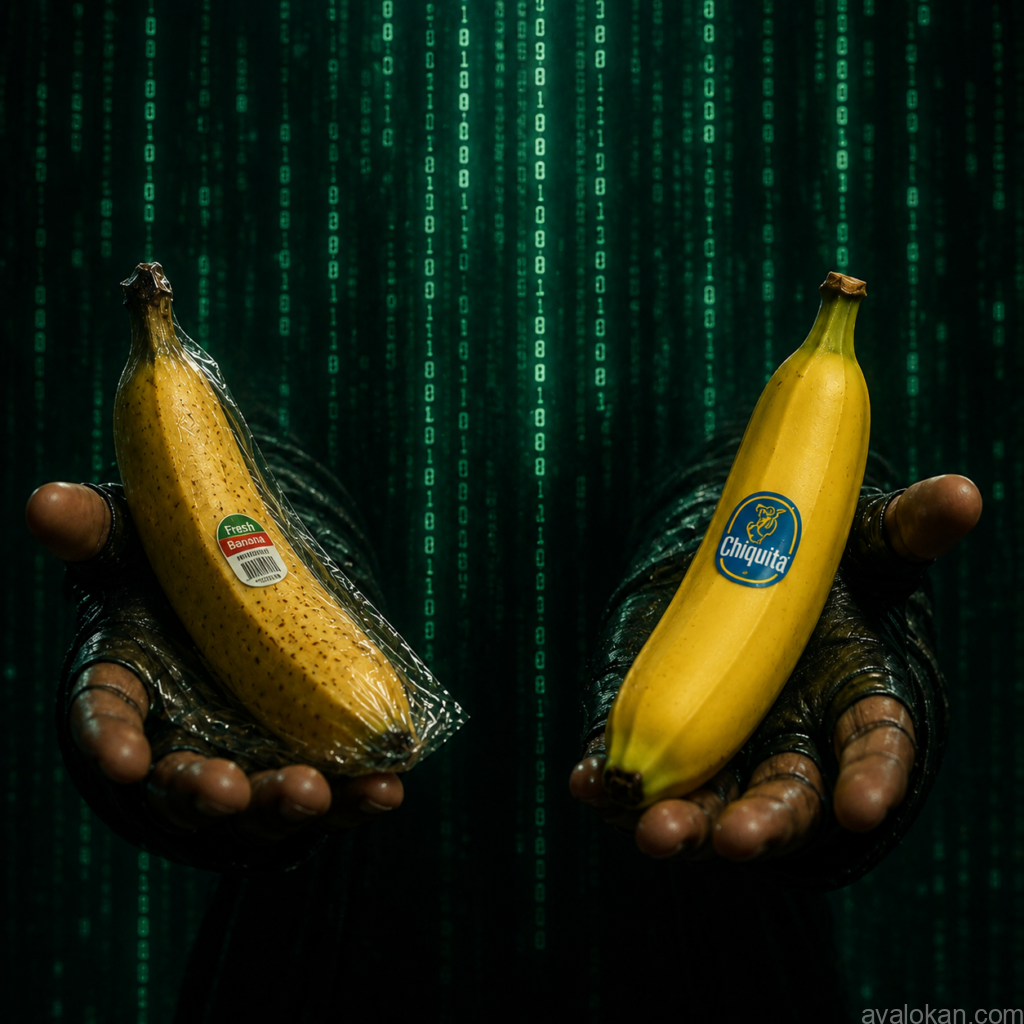
I have always loved bananas. When I first moved to the UK, years before this country would become home in the fullest sense, one of the first pieces of practical wisdom I received from a friend was beautifully simple: “If you want good bananas here, buy Chiquita.” I still remember thinking this was an oddly specific immigration tip. Some people tell you about the weather, rent, council tax, GP registration and which side of the road to look before crossing. My friend gave me the real survival guide: find the right banana.
And to be fair, he was right. Chiquita bananas really are excellent. I would describe them as 108% banana: a banana with enhanced banana magic. A banana that has understood its purpose in life. A banana that has completed all mandatory training and still somehow retained its soul. They used to be easy to find and fairly cheap. These days, they feel like rare objects of devotion. Whenever I find them now, I buy them at almost any available cost, like a man quietly investing in yellow gold. The trouble is, most ordinary supermarket bananas I find these days rarely have that same confident banana-ness. They are bananas, yes, but sometimes more in theory than spirit. Chiquita, by comparison, still feels like the benchmark.
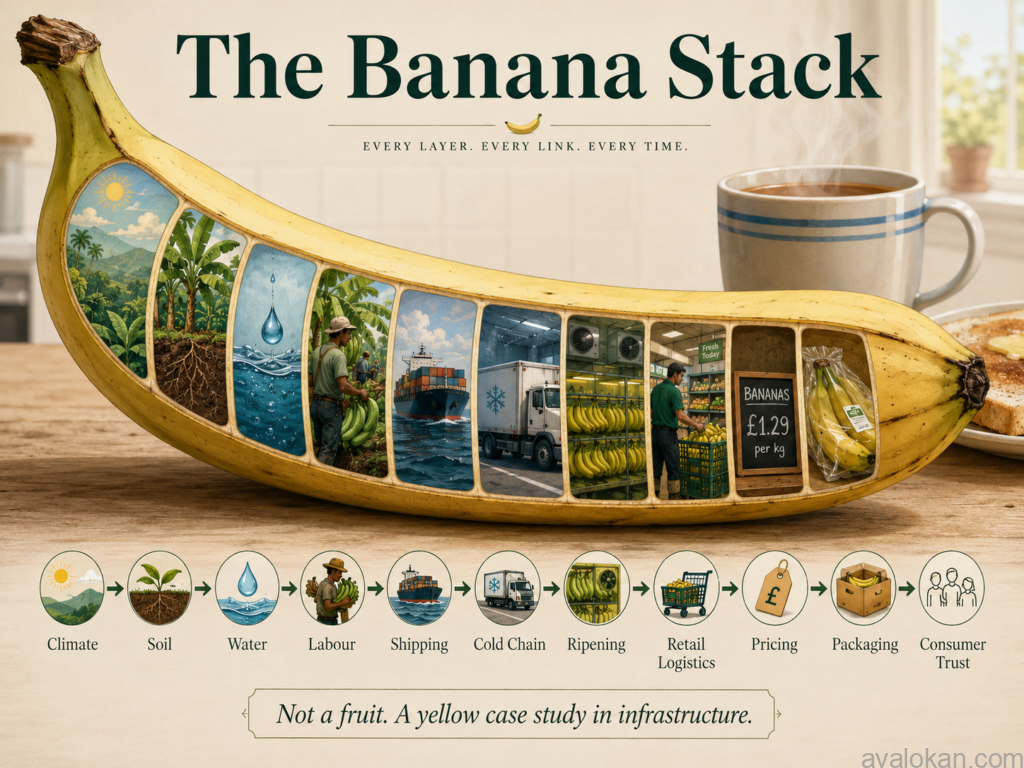
This week, while everyone seemed to be talking about national productivity, innovation, AI, biotech, quantum computing, growth strategies, data centres and economic resilience, I opened a pack of British supermarket bananas. Of course, the bananas themselves were almost certainly grown far away, in warmer regions where the climate naturally supports banana growing. Britain has many talents, but commercial banana plantations are still waiting for their strategic delivery board. Tesco’s banana supply, for example, has historically come from countries in Central and South America, as well as parts of West Africa. The fruit may arrive in a British shopping basket, but its biography is international. That made the whole thing funnier and more revealing. A banana in a British supermarket is already a global technology stack: tropical climate, soil, water, plantation labour, shipping, refrigeration, ripening rooms, retail logistics, pricing, packaging and consumer trust. By the time it reaches the kitchen table, it has travelled through more systems than some national transformation programmes. It is less a fruit and more a yellow case study in infrastructure.
Perhaps this is how many strategies begin. We see something successful elsewhere, copy the label, polish the brochure and hope the fruit catches up later. “Copy Chiquita. Deliver Banana” sounds absurd, but it captures a familiar pattern. Copy the surface. Miss the system. Copy the technology. Miss the culture. Copy the dashboard. Miss the decision-making. It is the banana theory of organisational transformation: impressive wrapper, uncertain interior. There is also a wider cost to all this. Inflation has made everyday judgement more emotional than it used to be. People now stand in supermarkets doing small moral calculations in front of fruit. “Is this banana worth it?” “Is this cheese now a luxury item?” “Does this tomato come with a mortgage adviser?” The general public pays for instability in tiny repeated moments: at the checkout, in energy bills, in transport costs, in rent, in childcare, in the quiet shrinking of what used to feel normal. Economic resilience sounds grand in speeches. In real life, it often looks like someone putting the nice bananas back.
Beach Day…
Over this same week, Britain had one of those rare moments when the sun appeared with full executive authority. The UK recorded its hottest May day on record on 25 May 2026, with temperatures reaching 34.8°C at Kew Gardens. I have been to beaches before, usually once a year, which is roughly how often the sun formally visits the UK. This time, I went to the beach and swam under a wide blue sky. The water was bright, the sun was generous, and fish moved quietly below while humans floated above with the elegance of confused seals. People of every background were there. Children ran around. Families laughed. Different languages mixed in the air. For a while, it felt as if the whole country had signed a peace treaty with itself. Nobody needed a productivity strategy. The sun had done the stakeholder engagement.
There was something ancient about it. Before AI strategies, quantum roadmaps and data-centre planning applications, there was simply sun, water, laughter, trust and people collectively remembering they had knees. It felt like a small festival for Ra, with a seasonal British branch office somewhere near Stonehenge, updated for modern life with ice cream vans, beach towels, portable speakers and aggressive levels of SPF 50. For a few hours, the UK looked almost tropical: children playing, families relaxing, strangers smiling, everyone behaving as if public joy had briefly been approved by committee. Perhaps communities in warmer climates have long understood something we briefly rediscover on rare sunny days: regular outdoor life, shared public space and real bananas grown in actual soil can do wonderful things to the human spirit. Britain gets a glimpse of that mood too, usually between 12:40 and 16:15 on one blessed Saturday in May, when even the stones seem to lean slightly sunward.
That beach scene stayed with me because technology discussions can become strangely detached from ordinary life. AI, quantum computing and frontier models often sound distant, but their purpose should return to human experience. AI brings pattern recognition, language, code, simulation, automation and reasoning support. Quantum computing, as it matures, may help with problems too complex for ordinary machines: materials, chemistry, optimisation, cryptography, logistics, drug discovery, climate modelling and perhaps fusion research. Together, they could become an extraordinary engine for discovery. AI says, “I found a pattern.” Quantum says, “Wonderful, I found fourteen million possible realities.” Somewhere nearby, management asks, “Can both be converted into a dashboard by Friday?”
If you are still with me, this is where I return to a thought from an earlier essay, where I imagined AI less as Don Quixote charging at windmills and more as Sancho Panza walking beside us: practical, observant, carrying the thread while humans get distracted by giants, dashboards and quarterly narratives. That image still feels useful here. AI begins as a companion, but companions learn from the road. They notice what gets repeated, what gets rewarded, what gets ignored, and what keeps returning in slightly better formatting. This is where I feel leadership becomes important in this narrative. Powerful tools amplify intent. In thoughtful hands, AI can help people understand complex systems, widen access, support better decisions and reduce cognitive load. In careless hands, the same tools can create very polished confusion at industrial speed. A frontier model can help someone write a brilliant research proposal, explain a difficult idea or design a better interface. It can also help someone produce a beautifully formatted email about “strategic alignment” that somehow makes everyone feel smaller by the third sentence. Previously, poor behaviour had typos. Now it has brand guidelines. This is also why the phrase “bad AI” feels too simple. Humans are already meeting AI long before they open a chatbot. They meet it through recommendation feeds, ranking systems, filters, auto-play loops, synthetic images, edited clips, targeted content and the strange little machine that decides what appears next on a screen.
To a novice or a child, AI rarely arrives with a label saying “frontier model,” “algorithmic recommender” or “AI-generated persuasion object.” It simply appears as the next video, the next challenge, the next rumour, the next joke, the next insecurity, the next thing everyone in family or at school has apparently already seen. This is why the current UK discussion around children and social media in general matters. The government’s “Growing up in the online world” consultation has been looking at issues such as minimum ages for social media, risky design features including infinite scrolling and autoplay, age assurance, mobile-phone guidance in schools and children’s use of digital technology. Ofcom has also reported that nearly three-quarters of 11–17-year-olds said they had seen harmful content online, while personalised feeds were a main route, with 35% saying they encountered harmful content while scrolling. At the same time, most children aged 8–17 said they felt safe and happy on social media and messaging services at least most of the time. That contrast matters. Children or even adults to a certain extent can feel comfortable inside systems that are quietly shaping what they see, what they compare themselves against and what they begin to treat as normal.
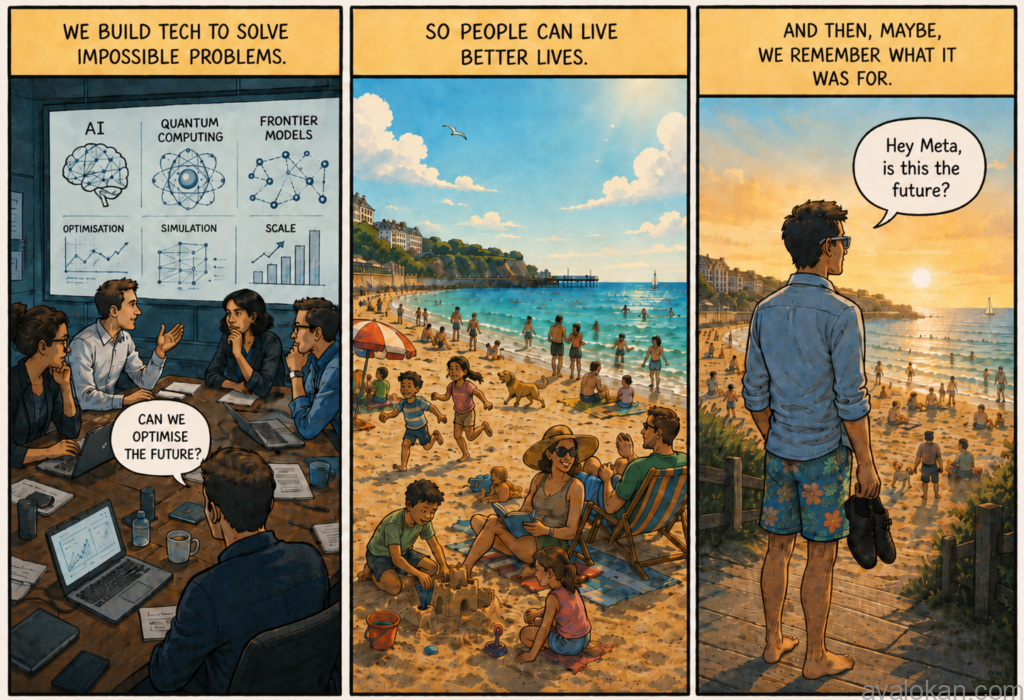
This brings the AI discussion closer to home. The concern is less about a dramatic science-fiction machine declaring itself evil, and more about ordinary children growing up inside systems optimised for attention, engagement and repetition. Add more generative AI into that environment, and the feed gains new powers: synthetic influencers, fake authority, personalised persuasion, endless content and emotional hooks tuned with unsettling precision. The machine does not need horns and red eyes. It only needs a pastel thumbnail, a catchy sound and a silly human with ten spare minutes before dinner. In this scenario, data centres make the story even more physical. AI feels weightless when it appears in a chat box, but behind it sit servers, electricity, cooling systems, water, land, cables and serious infrastructure. The more powerful the models become, the more visible their physical footprint becomes. Add quantum computing to the picture and the future begins to look both exciting and demanding. We may gain extraordinary new capabilities, but capability alone is a small word wearing a large hat. The bigger question is what we choose to optimise for: speed, control, understanding, trust, public value, human flourishing, or simply more bananas, delivered faster, with better packaging and a more confident quarterly narrative…
Can AI Make Bananas Great Again?
This is where the banana becomes the 108% banana. “Can AI make our bananas great again? At this point, I am willing to personally fund the pilot.” Well Nano-Banana can certainly generate a beautiful image of one. Using generative AI, it can produce a perfect golden banana, sitting heroically under soft studio lighting, with familiar symbols blurred tastefully in the background and perhaps a small slogan saying “locally imagined.” But generating an image is easy. Growing a real banana is harder. A real banana needs the right climate, soil, water, labour, logistics, biodiversity, farming knowledge, energy, storage, transport and time. The pixels are instant. The fruit has to grow somewhere real. That distinction matters for almost everything we call innovation. AI can help us design, simulate, predict, optimise and communicate, but reality still sends invoices. Food has to be grown. Energy has to be generated. Data centres have to be powered and cooled. Supply chains have to work. People have to be treated fairly. The environment has to be protected. Public trust has to be earned. The general public deserves to share in the benefits of innovation through better services, fairer systems, cleaner growth and, ideally, bananas that arrive with both flavour and dignity and… ahem… shelf life.
The supermarket gave me the banana. The beach gave me the sunlight it was missing, and perhaps… the operating manual too.
People on the beach seemed happy because, gradually, the conditions around them made trust, openness and ease feel natural. The sun created a shared space. Nobody needed to be managed into Teams call or SharePoint collaboration. Nobody needed a workshop on “cross-functional warmth alignment.” The environment made generosity easier. Perhaps that is what good leadership should do in the age of AI: create conditions where intelligence, human and artificial, can serve understanding rather than anxiety. The best technology cultures will use AI to help people think better. The weaker ones might use it to sound clever… a bit faster. So before every organisation rushes to become AI-first, quantum-ready and innovation-led, perhaps there is a simpler test. Can it create a culture where people feel safe enough to think, question, learn and contribute meaningfully? Can it tell the difference between leadership and bullying? Can it recognise genuine innovation before it becomes a banana wearing a TED Talk T-Shirt? Can it use powerful tools to reduce pressure on ordinary people rather than quietly passing the cost down the chain?
I still love bananas. I still look for Chiquita when I can. Maybe that is nostalgia, maybe taste, maybe the memory of arriving in a new country and being given one unexpectedly useful piece of advice. But it reminds me of something simple. Great things rarely happen because someone copies the label. They happen because the conditions are right, the care is real, and the work behind the scenes is taken seriously.
Generative AI can create the perfect banana in seconds. But growing one still requires the world...