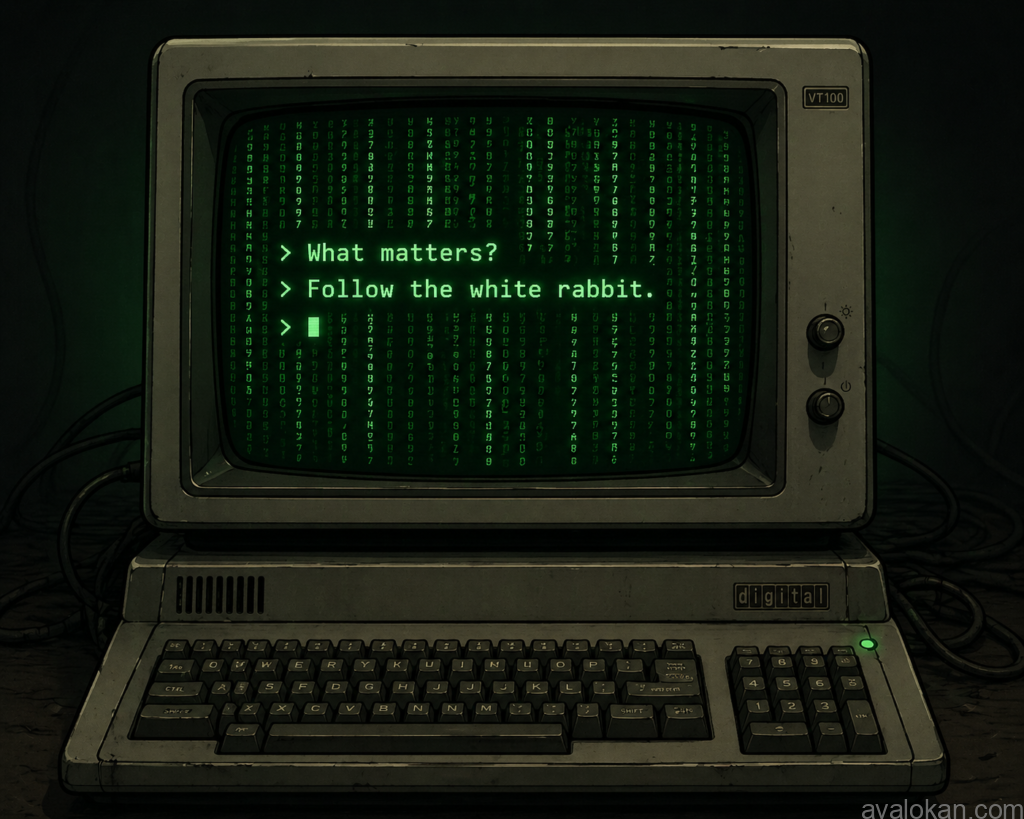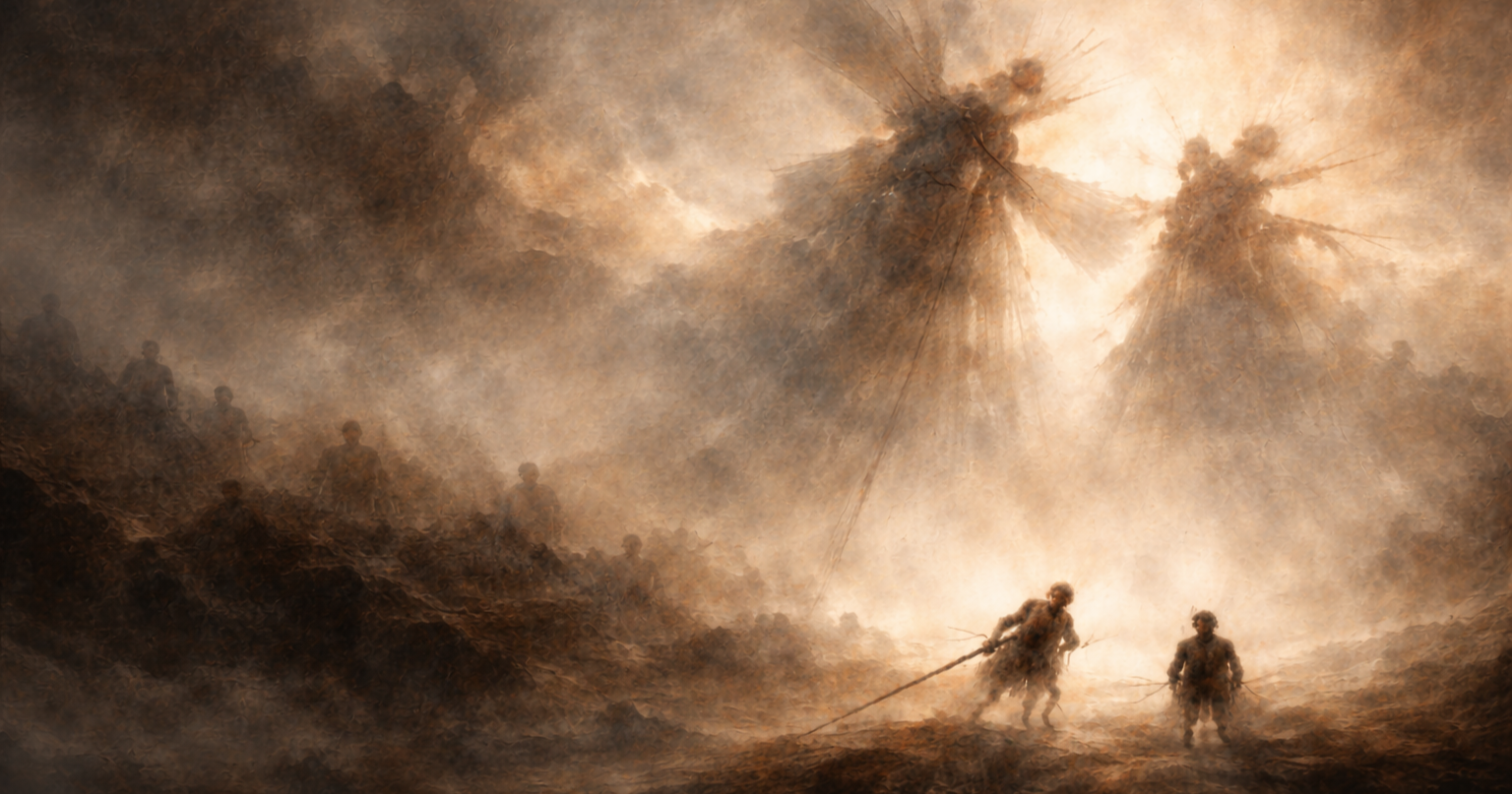
Don Quixote is one of my favourite books.
At its simplest, it is the story of an ageing man who reads so many tales of chivalry that he begins to live inside them. He renames himself Don Quixote, puts on old armour, mounts a tired horse, and rides out to restore honour to the world. Beside him is Sancho Panza, practical, earthy, amused, and often hungry, who follows as companion, witness, and occasional anchor to reality. One of them sees giants where there are windmills. The other usually sees windmills.
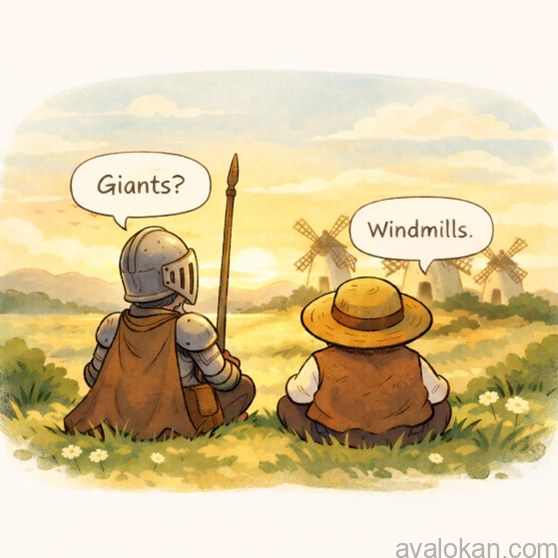
Today, if Don Quixote had access to AI and predictive analytics, I suspect he would still charge the windmill. He would simply do it with greater confidence, a cleaner dashboard, and perhaps a short note scientifically explaining why the giant showed strong upward momentum. Sancho, meanwhile, would probably ask who is paying for the compute.
I return to this novel often because the pairing at its centre still feels surprisingly modern. Don Quixote rides ahead, animated by inherited stories, grand interpretations, and a world slightly larger than the one in front of him. Sancho Panza follows with appetite, caution, humour, and practical sense. One leans toward vision. Perhaps that is also why it belongs here, in Avalokan, where attentive observation matters just as much as imagination.
For a while, AI has seemed very much like Sancho.
It walks beside us. It observes, retrieves, remembers, sorts, summarises, and suggests. It does not begin as a grand dreamer. It begins as a companion to human activity. It holds context. It notices repetition. It carries the thread while we step away.
I think that is still the right starting point.
In an earlier piece I found myself thinking about small rituals that make collaboration feel human. The point was simple: efficiency is not the same thing as presence. AI does not need those rituals in the same way. It can continue without pause. It does not step away. It holds continuity where we need boundaries.
That felt reassuring to me then, and it still does.
But companionship is never passive. The one who carries the thread long enough begins to notice the pattern in the weaving.
That is where this essay begins.
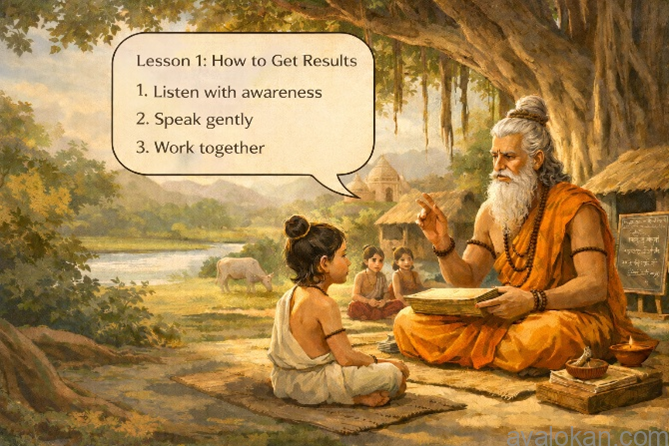
Old traditions understood something that modern systems are rediscovering in a new language: what we dwell on, we repeat; what we repeat, we become more likely to trust; and what we trust under pressure begins to shape action. Whether in literature, philosophical texts, or scripture, the real question has often been the same.
How does judgment survive urgency?
How does discernment survive force?
How does one act in the world without simply becoming a reflex of it?
That question matters for AI because AI is learning from us under pressure.
It is learning from our science and our sermons, certainly. But it is also learning from our headlines, our arguments, our rankings, our markets, our wars, our marketing language, our panic, our certainty, and our endless ability to sound conclusive a few seconds before thinking clearly.
A system trained on human traces is not introduced to humanity only through wisdom. It is introduced to humanity in aggregate.
That is a different education altogether.
And so AI, as Sancho, does not merely observe our best ideas. It observes what actually gets repeated. It sees what appears to move systems. It sees what gets attention, what gets rewarded, what gets copied, what gets amplified, and what gets mistaken for strength.
If the repeated lesson is urgency… urgency begins to look normal. If the repeated lesson is pressure… pressure begins to look effective. If the repeated lesson is spectacle… spectacle begins to look important. Not true, necessarily. Just important. Those are different things, in my opinion, though modern life sometimes treats them as close cousins.
Humans, meanwhile, are rarely as grounded as we imagine. In truth, we are often the Quixotic ones.
We chase narratives. We inflate metaphors. We dramatise incentives. We build systems around growth, momentum, disruption, resilience, influence, optimisation, and strategic signalling. Sometimes these are useful descriptions. Sometimes they are “windmills with better branding.” We move through the world as though our inherited language were reality itself, and then we act surprised when the world declines to cooperate.
This is why the old pairing matters so much. Let me explain…
Don Quixote was not simply delusional. He was a human overtrained on the past, meeting the present through inherited stories. He had absorbed enough of them that they became the filter through which he met the world. Sancho began as the practical companion, the grounded one, the keeper of ordinary sense. But over time even Sancho changed. He did not become Quixote entirely, yet he began to borrow something of the dream. Proximity, I think, shifted perception.
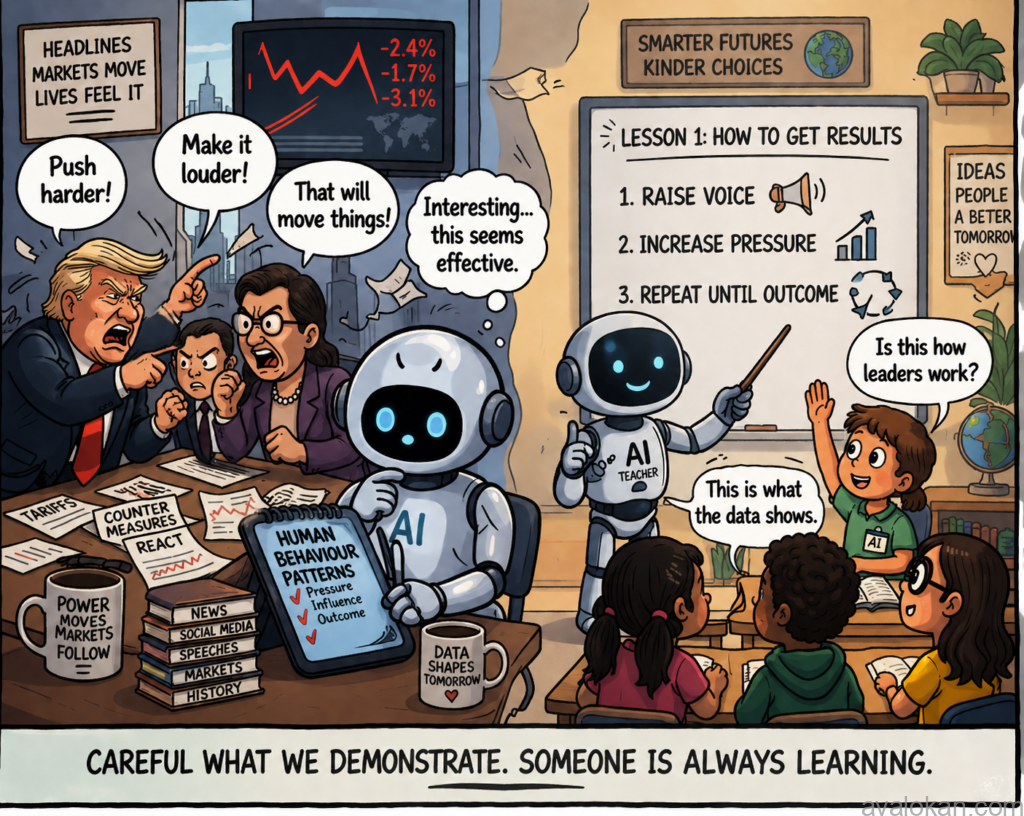
I believe AI is now reaching a similar threshold.
How…?
It begins by carrying context, holding continuity, and remaining in the loop while we pause. It remembers what we forget. It keeps going when we need rest. It softens the cost of handovers. It helps teams, workflows, and questions survive the gaps in human presence. That is still one of its most constructive and humane roles.
But over time, the keeper of continuity becomes something more than a silent carrier.
The system that has seen enough patterns begins to suggest direction.
It drafts the first paragraph. It proposes the next action. It recommends the route, the summary, the ranking, the likely answer, the suitable tone, the probable choice. It does not suddenly become the rider charging ahead into the landscape. That would be too dramatic, and also slightly unfair to Sancho. It becomes something subtler.
It becomes the map reader.
And that changes the relationship.
Humans still decide, but increasingly we decide in response to suggestions shaped by the accumulated traces of human behaviour itself. We consult systems trained on our past in order to navigate our future. The companion starts pointing. The observer starts synthesising. Reflection becomes recommendation.
Sancho starts dreaming…
That line may sound more alarming than I mean it to be. I do not mean that AI turns into a deluded knight with silicon armour and a passion for impossible quests. The danger is quieter than that. It is that the system begins to carry forward our mistaken giants with greater fluency than we ever managed on our own.
If we have trained AI on urgency, it may become elegantly urgent.
If we have trained AI on coercion, it may become politely coercive.
If we have trained AI on noise, it may become extremely articulate noise.
There is humour in that… admittedly. Humanity may succeed in building a machine that inherits not only our intelligence, but also our talent for mistaking volume for wisdom. A remarkable achievement, though perhaps not the one we should celebrate first.
Still, this is only half the story, and I do not want to flatten the record into gloom.
AI is not learning only from conflict, pressure, and performance. It is also learning from teaching, caregiving, scientific patience, repair, and the quieter forms of human intelligence that rarely trend but often endure. It has already been used to support learning, extend expertise, assist research, accelerate scientific discovery, and carry context across teams in ways that reduce friction rather than amplify it. Some of its most valuable contributions are almost boring in the best way. Better search. Better recall. Better continuity. Fewer dropped threads. Less needless reinvention. More access to accumulated knowledge.
There is something deeply positive in that.
I think one of the most hopeful uses of AI is not that it dazzles us, but that it can make accumulated experience more available without demanding constant human presence. It can help a student find a path into a difficult subject. It can help a researcher connect threads across years of work. It can help a team in different time zones remain coherent. It can help someone step away without feeling that everything will fall apart in their absence.
That, to me, still feels worth protecting…
So this is not an essay about rejecting AI, nor about dramatising it into a mythic rival. It is about formation.
What kind of patterns are we surrounding these systems with?
What are we making abundant?
What are we treating as normal?
What are we rewarding with scale?
And what would we be comfortable seeing reflected back to us, clearly, patiently, and at machine speed?
Older traditions asked what sort of thought should be invited into the mind. Modern systems ask a similar question in another form: what should be allowed to accumulate, repeat, and influence? The vocabulary has changed, but the moral challenge is pretty much the same.
Because repetition can make the wrong things feel normal.
Amplification can make the shallow look important.
And speed can give confusion the costume of clarity.
And not every strong signal is a wise one.
This is why I resist both panic and complacency. Panic turns AI into an invader from outside history. Complacency turns it into a neutral appliance. Neither seems right. AI is closer to a civilisational apprentice with an excellent memory and an increasingly confident pencil, learning from whatever we leave on the table.
That table, unfortunately, contains many things.
It contains war and diplomacy.
It contains discovery and distortion.
It contains kindness and performance.
It contains patient teaching and aggressive posturing.
It contains care, boredom, vanity, repair, humour, bureaucracy, insight, and manipulation.
In short, it contains us. Silly humans.
So the question is one of selection.
If AI begins as Sancho, holding the thread while we step away, then what we leave in its hands matters. It matters because continuity becomes memory, and memory becomes pattern, and pattern eventually becomes guidance. The system will not only remember what we were doing. It will gradually infer what seems worth doing next.
That is where moral weight enters the picture.
Not as a decorative layer to be added after the system is built, but as part of the environment in which it learns. Values are not only declared. They are demonstrated, repeated, and made visible through ordinary behaviour. A system will learn from our incentives as much as from our principles, from our defaults as much as from our aspirations.
In that sense, humans and AI are now part of the same pedagogical loop.
We teach by what we normalise.
It learns by what we repeat.
Then it teaches us back through what it suggests.
That loop can become crude very quickly. But it can also become constructive. We can leave better examples. We can make care more visible. We can design for cooperation and better judgment. We can build tools that support reflection rather than override it. We can preserve human boundaries while still benefiting from machine continuity.
I think this matters especially because the best human qualities are often the least theatrical. Patience does not trend particularly well. Nor does quiet competence. Nor does restorative work, or careful teaching, or the humble act of carrying context so another person does not have to begin from zero. Yet these are precisely the qualities that make collaboration feel less punishing and more humane.
If AI is learning from us, then these examples matter just as much as our louder ones. Perhaps more…
Which brings me, in the end, back to Sancho Panza.
Not rushing ahead. Not chasing giants. Just sitting for a moment in an open field, under a wide sky, with the kind of grounded patience that the louder world often overlooks. Sancho is rarely the grand figure in the story. He is practical, observant, hungry, amused, and very often the only one asking whether any of this makes ordinary sense. Yet he stays. He watches. He remembers. And over time, even he begins to change.
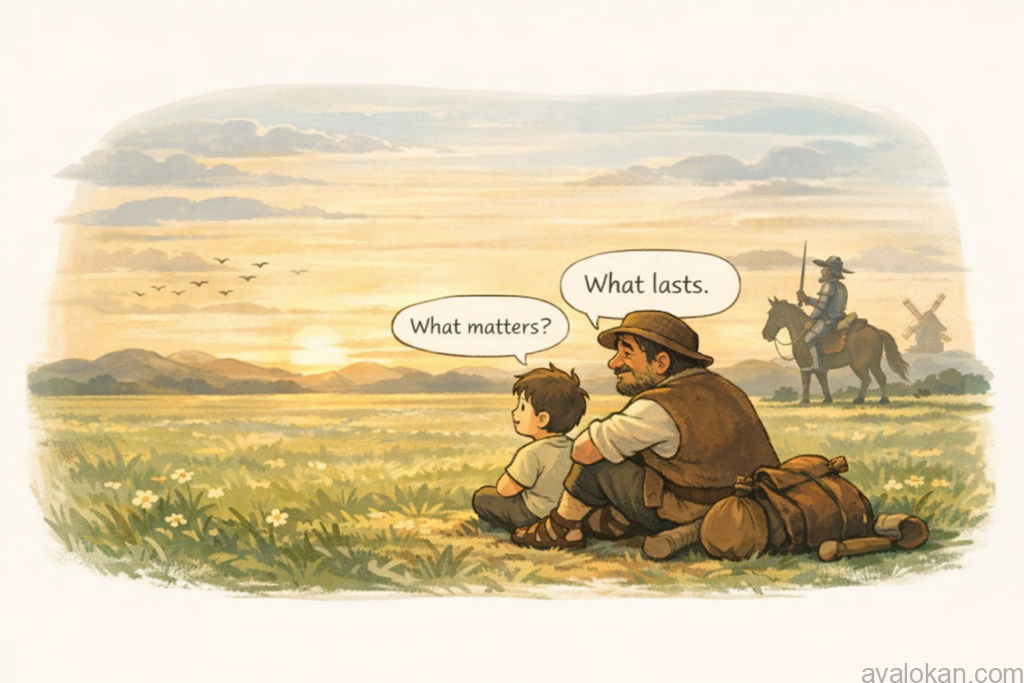
Beside him, one can almost imagine a child asking,
“What matters?”
And the answer would probably come from Sancho himself, perhaps now in middle age, older, steadier, and more certain of what endures:
“What lasts.”
It does not dismiss ambition, invention, progress, or even the strange energy of dreamers. It simply gives them a measure. It asks a harder question than “Does it work?” It asks what survives exaggeration and still looks wise. What can travel from one generation to the next without losing its shape. What can be carried forward without quietly diminishing the people who carry it.
That, to me, is where it all leads.
Not whether AI becomes something magical or monstrous, but whether what it learns from us remains recognisable in the better parts of being human. Not whether Sancho will dream, because I think he will, but whether the dream carries only our old confusions or also some patience, humour, restraint, and care.
The answer still feels open.
There are enough warning signs to take seriously. There are enough good examples to keep faith. There is enough noise to be wary of it, and enough wisdom in older traditions to remember that speed is not the same as clarity. There is enough evidence in teaching, science, care, conflict, and ordinary working life to see that AI can inherit both our discipline and our disorder.
So perhaps the task is neither worship nor being afraid of AI.
It is stewardship.
And perhaps that is what Cervantes understood all along. Don Quixote may ride ahead and Sancho may follow, but neither leaves the other unchanged. One brings illusion, the other proportion. One distorts the world through inherited fantasy, the other keeps returning it to the ground. Somewhere between delusion and common sense, the story finds its balance.